How the Duomo is built
A Gothic cathedral in Candoglia marble, with a roof you can walk on.
- Candoglia marble
- 135 spires
- 3,400+ statues
In short
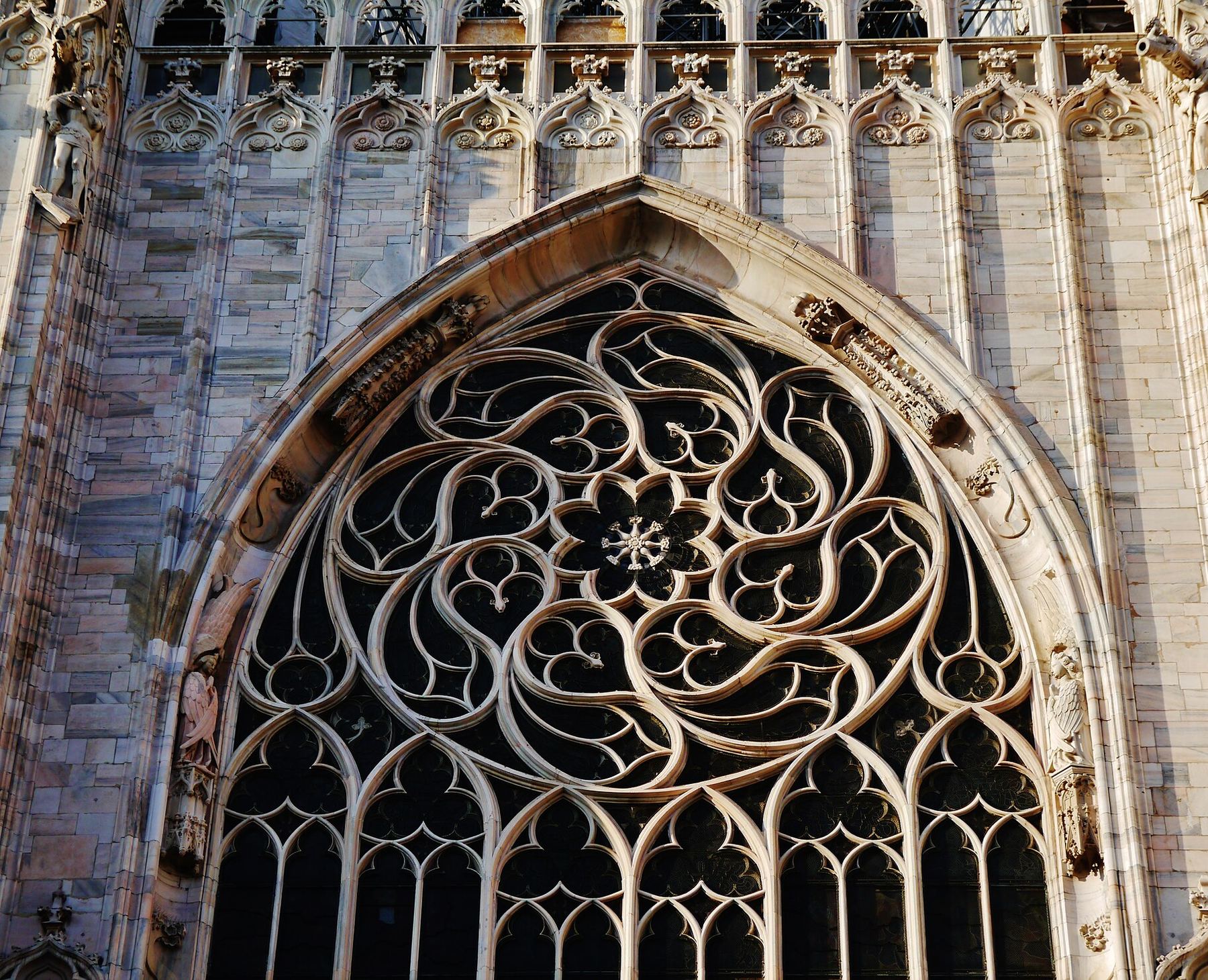
- The Duomo is a Gothic cathedral built from Candoglia marble, a choice that broke with Lombardy's tradition of brick.
- Its roof holds 135 spires, most about 17 metres tall, and over 3,400 statues stand on the building.
- The façade came last: its completion dates to 1807–1813, and the doors to between 1909 and 1965.
- The maximum height is 108.5 metres. We found no official length or width, so we do not quote one.
The stone came first
In Lombardy a great church meant brick. Gian Galeazzo Visconti decided otherwise and chose marble from Candoglia, in the municipality of Mergozzo in Piedmont, and on 24 October 1387 he ceded the quarry to the Veneranda Fabbrica. That decision also set up a long supply line. Blocks travelled by water, down the Toce, across Lake Maggiore, along the Ticino and the Naviglio Grande to the docks at Sant'Eustorgio. Marble was still arriving this way until 1920.
Why the spires stand in ranks
Gothic buildings push outwards as well as down. The load of the vaults goes into tall piers and from there out to buttresses, and a heavy pinnacle on top of a buttress helps to hold it in place. The spires along the Duomo's roofline follow that logic, and on two levels you can walk among them, which shows you more of how the building works than the nave does.
The count on the outside
| Element | Official figure |
|---|---|
| Spires | 135, most about 17 m tall |
| Statues | Over 3,400 |
| Gargoyles | 150 |
| Giants | 96 |
| Corbels | 410 |
Gargoyles are the working part of the decoration: they throw rainwater clear of the walls. Giants and corbels are easier to read from under the walls than from the middle of the square.
Why the façade looks like two buildings
The lower portals and windows belong to a later classical taste, while Gothic spires and tracery run above. Napoleon gave the final push: the official history dates the works that completed it to 1807–1813.
Read it from the bottom up.
- The doors, dating from between 1909 and 1965, are the newest large element.
- The inscription Mariae Nascenti gives the dedication to Mary at her birth.
- The top, where the Gothic outline finally meets the Main Spire behind it, seen best from a distance.
If you want to know what the words duomo and cathedral mean, see what a duomo is.
The tiburium and the Main Spire
Over the crossing rises the tiburium, the structure around the dome, and on top of it the Main Spire, built in 1765–1770 under Francesco Croce to carry the Madonnina. Together they make the skyline you recognise from a distance.
A building under permanent repair
The Fabbrica has been at work since 1387. Restoration of the tiburium and dome began in 2016, and recent work has covered the North Capocroce, the end of the north transept. The Adopt a Spire campaign, launched in 2012, is the public side of that bill. For you, it means some part of the exterior may carry scaffolding, and no official page says which part at a given moment.
One thing to try
From the south side of the cathedral, look up the wall and count the layers: wall, window, buttress, pinnacle, statue. Then go up on the roof and see the same layers from behind. The dated history covers who did what, and when.
To see it from the roof

Duomo di Milano: Entry Ticket + Rooftop Access
- Cathedral
- Rooftop
Tiqets★ 4.6 · 13,545Free cancellation
from €27Book
Duomo di Milano: Guided Tour + Rooftop Access
- Cathedral
- Rooftop
- Priority entry
- Guide
Tiqets★ 4.3 · 64Free cancellation
from €74Book
Duomo di Milano: Guided Tour + Rooftop Access
- Cathedral
- Rooftop
- Priority entry
- Guide
Tiqets★ 4.9 · 18Free cancellation
from €69Book
Milan: Fast-Track Milan Cathedral and Terraces Guided Tour
- Cathedral
- Rooftop
- Museum
- Archaeological area
- Priority entry
- Guide
GetYourGuide★ 4.6 · 5,853
from €39Book
Partner prices refresh daily; the final price is the one shown at checkout.
Frequently asked questions
What style is Milan Cathedral?
What is the Duomo made of?
How many statues are on Milan Cathedral?
How big is Milan Cathedral?
Sources
Information checked on 4 November 2026.
- Veneranda Fabbrica del Duomo, history of the Duomo
- Veneranda Fabbrica del Duomo, the Terraces
- Duomo di Milano, the Madonnina in numbers
- Duomo di Milano, Candoglia marble and quarry
Independent guide: we are not the official Duomo website or the Veneranda Fabbrica.